
Wulff Projection
The basis for all projection techniques is the imaginary reference sphere of radius R, positioned with its centre at the centre of the area of projection. Consider a line oriented with the trend a and plunge b, and positioned so that it passes through the centre of a reference sphere. If this line is extended, it pierces the perimeter of the reference sphere at two points: P on the lower hemisphere and Q on the upper hemisphere.
A point on the lower hemisphere, such as P, can be projected onto the horizontal plane using different projection methods. Stereonet supports equal-angle and equal-area projections. The Wulff projection is the equal-angle method. The Schmidt Projection is the equal-area method.
The Wulff projection is a conformal, azimuthal projection that dates back to the Greeks. Its main use is for mapping the polar regions. In the polar aspect, all meridians are straight lines and parallels are arcs of circles. This is the most common use, but any point can be selected as the centre of projection.
The polar equal-angle net is used with the equal-angle stereonet to plot normals, or poles, to the discontinuities. By comparison, the polar equal-area net is used with the equal-area Schmidt stereonet to plot poles. Counting nets are used with both projection types to determine clusters or concentrations of orientations.
For an equal-angle Wulff projection, the given line of trend a and downward plunge b intersects the lower reference sphere at point P'. If a straight line is drawn from P' to a zenith point, Z, which is at a distance R vertically above the centre point, O, the line intersects the plane of projection, which is the horizontal plane, at P.
For this projection, the relationship between r, the radial distance of point P from O, and b is given by:
r = R tan(b/2)
The trace of a great circle of dip direction ac and dip bc on the equal-angle projection has a radius Rc given by:
Rc = R / cos bc
The centre point is given by:
rc = R tan bc
Where:
-
rc is the horizontal length from point O in the opposite direction of ac.
-
Rc is the radius of the great circle of dip direction ac and dip bc.
The following diagram compares Wulff equal-angle and Schmidt equal-area projections:
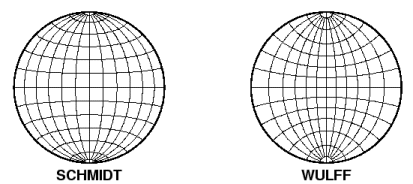
Reference: Rock Slope Stability by Charles A. Kliche, published by SME, 1999.
Related topics and activities:
